
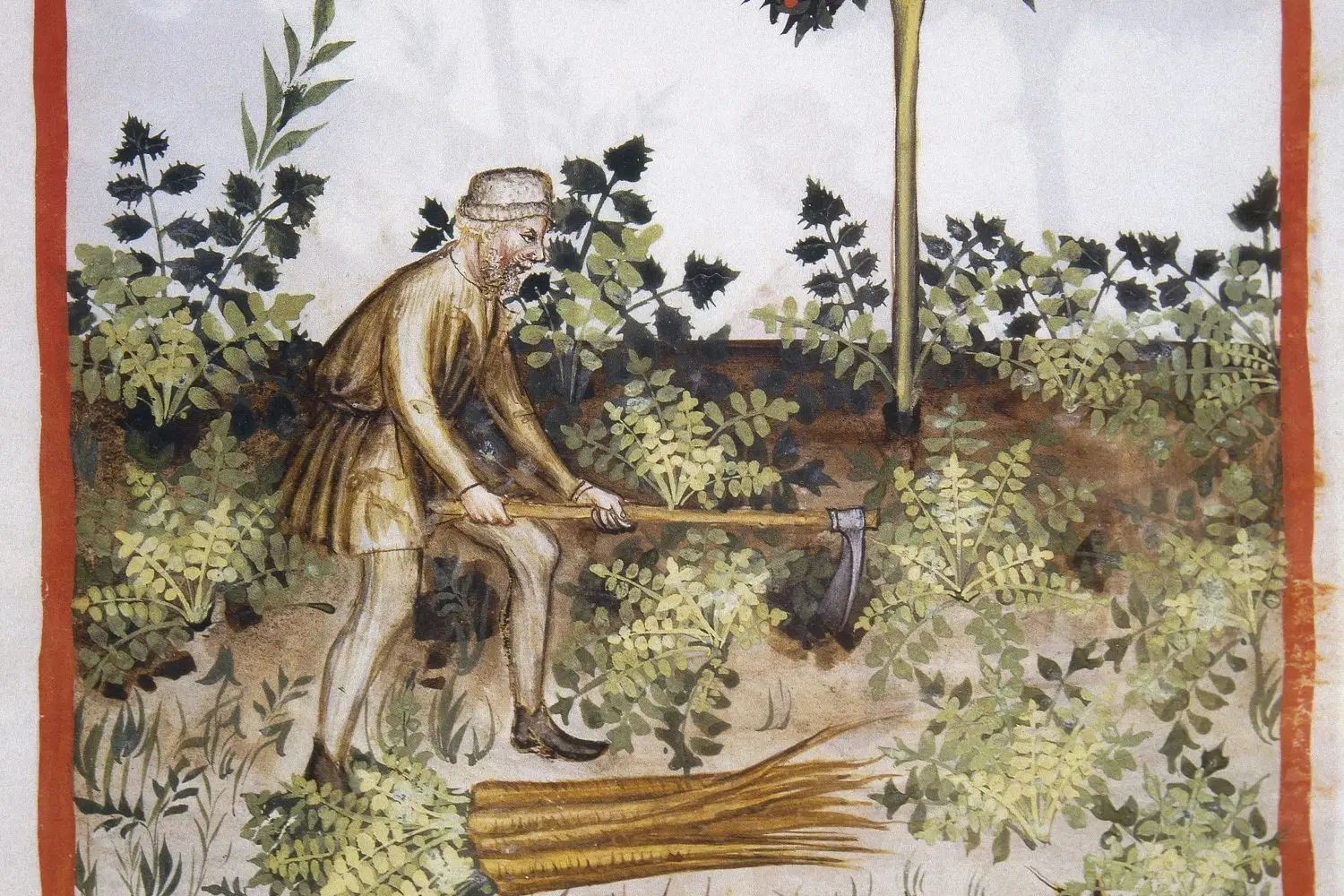
Workday in the park…….19th September 2026….
Many thanks to the volunteers who came along 19th September to dig in (geddit?) and make the park lovely for the autumn season:
Ann C, Bruno, Ed, Glen, Gordon, Hannah W, Helen, Jon, Judy, Julia, Mike, Rebecca, Shereen, Sienna, Timothy and Tom. Welcome to Sienna, a new volunteer.
It was such a nice change to not to have rock hard flower beds! We accomplished many things including (but not limited to)
Dividing and replanting several types of plants in and between the ‘Long Bed’ and ‘Centre Isle.’
Adding cyclamen to the Centre Isle for some instant colour
Dividing and replanting plants in the Star Bed and Border, adding mulch and planting ajuga and heuchera
Extra watering of new shrubs in the perimeter that are competing for water from established trees and shrubs.
Tidying and cutting back sycamore saplings along the perimeter beds.
Cutting back roses overgrowing into paths.
Tackling the long unwanted grasses along the bowling fence near the toddler area.
Doubling the usable pathway between the basketball area and path to Park Road by cutting back overgrown shrubs.
Putting up posters around the Toddler area and Park Notice Boards for the Halloween event.
Leaf raking along the path to Buckingham Road.
Again, many thanks to all who came along. The next garden day will be the next third Saturday of the month, 17th October 2026, 10am-12noon. Please do join us!
Halloween festival, 24th October 2026

The annual Halloween festival in the park, on Saturday 24th October is a modest fundraiser for the park, but also a fun occasion of community connection. The sociologist Emile Durkheim coined the term “collective effervescence” to describe the feelings of community and belonging. Large gatherings create a sense of “identity fusion”, as individuals feel they belong to a group. Participation in a collective event affects participants’ social identification and behaviour. The park’s Halloween event is not on the same scale as Burning Man, an event in Nevada, USA, an event of “community, art, self-expression, and self-reliance”, or Burning Nest, “ a week of art, play, and mischief in a Devon woodland”, …..but it shares the attributes of a volunteer-built community experiment. You don’t just attend, you participate. The events generate a sense of generosity, of goodwill; our park event has the additional recommendation of involving participants in a nature setting, with its sense of timelessness, renewal and peace.
The event is also a good indication of how the recognition of “All Hallows Eve” has changed over many years. The modern imagery of Halloween comes from an astonishing mixture of sources, from Christian eschatology to Celtic spiritualism, Irish folklore and horror films. Americanization is often blamed for the bowdlerisation of very old Celtic rituals. Costumed ninjas and Disney princesses are now as common as vampires, ghosts and skeletons; “guisers” now present themselves as “trick or treat”, seeking sweets, and no longer seem to carry jack-o-lanterns to frighten off evil spirits.
The “jack-o-lantern” carries an astonishing symbolic magnitude, in a wandering folktale which is often very carefully crafted. “Stingy Jack”, a drunkard, fooled the devil twice, and the devil had to promise never to claim his soul. After death Jack wandered the earth in eternal darkness, denied entry to both heaven and hell, until the devil tossed a burning coal at him. Jack placed it into a hollow turnip, which he used as a lantern, to light his path between heaven, for which he was unfit, and the hell which refused to take him. An intermediate or transitional afterlife state, or purgatory, could hardly be imagined more subtly; here folklore does indeed act as a sort of database of community concerns and fears.
US sociologist Amitai Etzioni describes Halloween as a “tension-management holiday”. In “Towards a theory of public ritual”, he discusses events like Easter and Passover as rituals of recommitment in society, whereas occasions like Purim, Oktoberfest, Mardi Gras and New Year’s Eve, April Fools Day, function to manage social tension, as forms of behaviour not normally allowed are indulged temporarily. Afterwards, people are expected to return to conformist modes of behaviour. Halloween presents many curious rituals which have become accepted during this holiday, if not normalised. Halloween has become bowdlerised and commercialised; it has evolved from a folk festival to a multi-billion dollar industry.
Penny for the guy no longer seems to exist, replaced by trick or treating. The Gunpowder plot, the burning of effigies are much diluted in friendlier scenes of cute kids in black bin bags and other disguises. The event has been largely stripped of its destructive and dangerous elements, and has become the safe and jolly neighbourhood festivity we know today.
Durkheim, Émile. The Elementary Forms of the Religious Life,1912
Etzioni, Amitai, Toward a Theory of Public Ritual Sociological Theory Vol. 18, No. 1 (Mar., 2000),
Disappointment at the Optimistic Picnic…… The “Optimistic Picnic” was an unofficial public gathering organized by Joe Reeve (co-founder of Looking For Growth), originally to be held in London one day in September 2026. It was described as:
Britain is full of optimists. We’re just terrible at admitting it.
So a few of us are having a picnic in Hyde Park to fix that. One afternoon, one very good park, and a load of people who reckon things can actually get better.
No agenda, no speeches, no one collecting your email at the door. Just good company, good weather (we’re optimists), and whatever you bring. Blanket, food, drink, and ideally someone who could do with cheering up. Nothing will be provided – it’s a picnic, not a wedding.
Families welcome.
A worthy attempt to build positivity and community in these sad and uncertain times? Happy people laughing and smiling and enjoying themselves? Boiled eggs, sandwiches, potted beef and lashings of ginger beer? Thick cut gingerbread and buns? Unfortunately, not. Some helpful person complained to The Royal Parks authority, which intervened beforehand, stating the unauthorized gathering of over 1,000 registered attendees required a proper event license, which had to be applied for weeks in advance.
Craftily, some aficionados decided to meet in very small groups, defy the trolls and snitches, and picnic in small unobtrusive clusters.
Come and picnic in our park……..Grab a basket and a blanket. Please don’t bring portable barbecues. Please take your litter home. Be philosophical about the ants. The grass will probably be very damp. Opportunist dogs will grab your sandwiches. A sudden bank of clouds may appear from nowhere. The sharp-eyed magpies will circle your cooler bags. The wasps are waiting at this moment for your freshly-squeezed apple juice. Give quiche a chance….. Enjoy!
The Rat brought the boat alongside the bank, made her fast, helped the still awkward Mole safely ashore, and swung out the luncheon-basket. The Mole begged as a favour to be allowed to unpack it all by himself; and the Rat was very pleased to indulge him, and to sprawl at full length on the grass and rest, while his excited friend shook out the table-cloth and spread it, took out all the mysterious packets one by one and arranged their contents in due order, still gasping, ‘O my! O my!’ at each fresh revelation…….
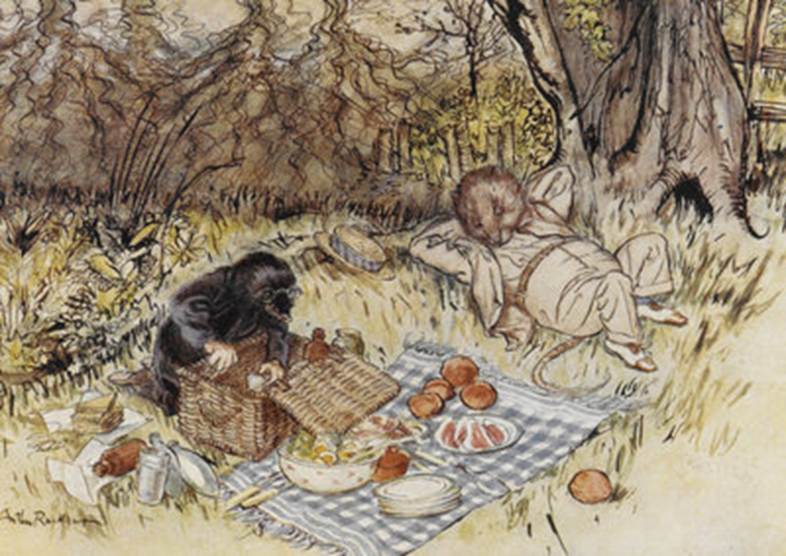
Image; Arthur Rackham
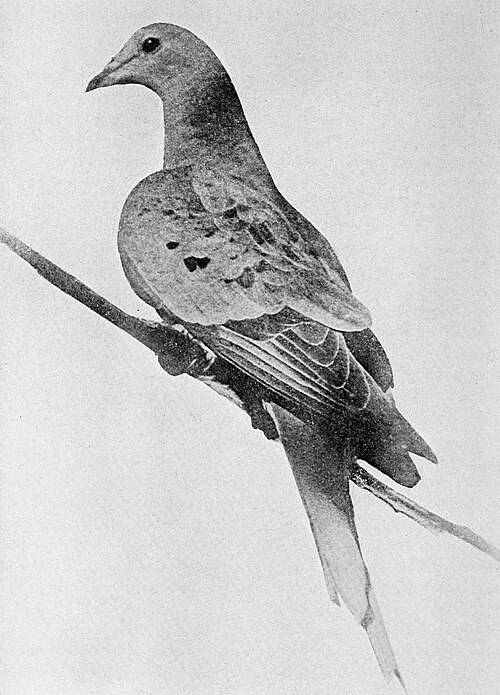
There was very possibly an endling in the park recently. An endling is the last known individual of a species or subspecies; when it dies, the entire species becomes extinct. The 4 April 1996 issue of Nature published a correspondence in which scientists postulated that a new word, endling, be adopted to denote the last individual of a species. Good examples are the Tasmanian tiger, or thylacine, or Lonesome George, the last Pinta Island tortoise. Martha, the very last passenger pigeon died September 1st, 1914 in Cinncinnati Zoo.
This particular endling in the park was a middle aged gentleman, in shorts and Birkenstocks, on his hands and knees in the wildflower corner, transfixed by something small growing in the ground. He was utterly silent, spoke to no one, took nothing but memories and left nothing but the slight impact of his sandals on the ground when he vanished into St James’ Road. He was not particularly meek, nor bespectacled, nor nerdy, and there were no seeds or dried leaves or wedges of moss spilling out of his pockets. But he was almost certainly a botanist.
Where are today’s botanists? There has been a marked global decline in botany education. Universities are facing very difficult economic circumstances, for a number of reasons and many courses have been cut. Botany, once a staple of any biology degree, is rarely taught. There is widespread lack of plant awareness among the general population, and this is hampering many efforts at environmental improvement. For example, 30% of newly planted trees die within the first year, according to the Forestry Commission, while the Arboricultural Association says it’s not uncommon for 70% of newly planted trees to die.
Research funding in universities has shifted towards the more glamourous and prestigious fields of genetics, biotechnology, and molecular biology. Students will naturally follow the molecular money. Yet basic botanical knowledge will be needed to solve difficult and looming climate and ecological crises.
In the USA in 1924, Duke University initially announced plans to close its herbarium, established in 1921, due to escalating maintenance and renovation costs.
https://www.dukechronicle.com/article/weve-grown-the-future-of-botany-here-20251002
Such was the outcry from major scientific societies that the University has now agreed to move the herbarium to the University of North Carolina.
Kew Gardens is asking the public for funds to preserve its iconic palm glasshouse:
Perhaps the salvation of botany will come from unexpected sources. A study highlighted by New Scientist revealed that 87% of Taylor Swift’s 61 official music videos feature botanical elements, which can be used by teachers to advance ecological concepts.
https://www.eurekalert.org/news-releases/1117252
(paywalled)
The botanical education extinction and the fall of plant awareness, by S Stroud et al https://doi.org/10.1002/ece3.9019
Are humans really blind to plants?, by S Knapp https://doi.org/10.1002/ppp3.36
Autumn is coming to the park subtly, on little cat feet. The glorious chestnut tree is spitting voluptuous conkers. The astronomical start date is 21st September. The chlorophyll in the leaves is beginning to break down; the three pigments that colour leaves are chlorophyll (green), carotenes (yellow) and anthocyanins (reds and pinks).
Birds will begin truly astonishing migrations, such as flocks of swallows heading for South Africa Waxwings, fieldfares and some types of ducks and geese head to the UK from Iceland and the Baltic countries. Insects will be burrowing into the leaf litter for diapause, to become dormant in a form of hibernation. Ladybirds and honeybees will huddle together for warmth descending into a semi-dormant state. The wither wood in the park is doing a marvellous job for many species, including woodlice, which seem to be in abundance……..also known as chuckypig, slater, pillbug, monkeypea, woodpig, ciggy wigs and granny grunters ………