
Tradition, killing things, virtual carrier pigeons, donkey taxis, brilliant birds……
Workday in the park……
A cool, partly cloudy morning was a great help to the Garden in the Park yesterday morning, but the excellent turn out of volunteers made the park look great – despite the overly long lack of water.
Many thanks to Anne B (task leader), ably assisted by Al, Ann C, Anna C, Ed, Hannah, Helen, James, Jeff, Julia, Mark, Mike, Rachel and Tony. Welcome to Rachel, a new volunteer.
Loads got done including –
- Extensive watering of new shrubs and plants, very much helped by those who brought extra watering cans. These were refilled (100+ times) on a continuous basis and then ferried by wheelbarrow to many corners of the park, including new perimeter shrubs, the Willow Crescent, Long Border and Clover-leaf borders. (Longer hose wasn’t used because the key to the outside tap area seems to have stopped working).
- Tidying and cutting back wayward greenery along Buckingham Road perimeter path.
- Clearing up dead growth from the Long border. Plants such as Rose Campion, acanthus were left to produce seeds/ be divided once the soil no longer acts as a cement substitute.
- Repairing the dry stone retaining wall around the Star Bed and elsewhere
- Tiding the edges of the tennis court.
- Freeing the Star Bed area of weeds, plantain and grass in the wrong places.
- Repairing the dry stone retaining wall around the Star Bed and elsewhere.
- Tiding the edges of the tennis court.
- Cutting back encroaching and wayward shrubs along paths.
- Mowing the football field, restoring its delineation.
- Tidying along the outside the bowler’s fence.
- Tidying and cutting back wayward greenery along Buckingham Road perimeter path
Many many thanks to all who came along. The next garden day will be the next third Saturday of the month, 19th Sept 2026, 10am-12noon.
Research
Lost species……a biology professor in the US has launched a new scientific journal to record lost species; it is open-access and designed to reflect global biodiversity trends: Journal of Lost Species. A “lost” species is one that has not been seen for ten years.
https://journaloflostspecies.org/index.php/jls
Insects. The oxygen and pressure physiology of upper elevational range limits in insects….. Reduced oxygen levels and air pressure at higher elevations may limit the ability of insects to move upslope to escape a warming climate …….. https://doi.org/10.1111/1365-2435.70416
Environmental crime……What fresh hell is this? Failure of political will makes crimes affecting the environment a worsening threat ….. climate crime, pollution crime, waste crime, forest crime, illegal fishing, wildlife crime, https://eia-international.org/news/failure-of-political-makes-crimes-affecting-the-environment-a-worsening-threat/
Let’s kill things…… A deeply worrying and very immediate threat to wildlife is the decline of the orang-utan; Borneo is burning. There is no end, seemingly to the demand for palm oil products, for the production of which forests are being cleared. Fires are smoldering in Indonesia, which is in a severe drought. Some of these are tropical peatland fires, which burn slowly, release high amounts of air pollution, and are difficult to extinguish. The habitat of orang-utans, pangolins and many other creatures is threatened. It would be an irremediable tragedy if the orang-utan were to become extinct.
Such a tragedy happened not long ago with the thyllacine, an animal which could have been saved had people stopped killing it and set up some reserves where it could survive. The last known thyllacine died on 7th September 1936 in Hobart Zoo.
In some parts of the world, it looks as if the wolf will become extinct for the second time. The Mexican gray wolf is the smallest subspecies of gray wolf in North America: one of the rarest and most threatened mammals. This weekend, Donald Trump issued an order to eliminate its protection and allow ranchers to shoot it.
The regional government of Asturias, Spain, has approved its annual wolf management control plan authorizing the lethal culling of up to 67 wolves through late 2027—the highest quota set during the current management cycle. Regional agricultural authorities justified the expanded kill order by citing 3,893 reported livestock injuries and €1.9 million paid in compensation during 2025. Yet Europe’s wolf population came back from the brink of extinction in the last thirty years, thanks to conservation efforts.
Desperately cruel bull runs still take place in Spain, despite some human fatalities. A 64-year-old woman lost her life after being gored by a bull during a traditional bull run in Aýna, Spain, on 5 September 2026. Another participant was injured, and local authorities cancelled the remaining festivities.
An interesting fact has come to light about the sacred tradition of the Guga hunt in a remote Scottish island.
https://www.seabird.org/conservation/scottish-guga-hunt
It appears that the doughty men of Ness have modified the “tradition” somewhat. Whilst their revered and doughty ancestors raced over the ocean waves in open, sail-powered traditional wooden boats—often referred to as Ness luggers (or Sgoth Niseach) and open skiffs— they now find it a little more convenient and safe to get to the killing fields in larger, modern commercial fishing vessels or trawlers that can safely handle the brutal North Atlantic. So much for ancestral connection and cultural pride.
Whiffs of hypocrisy anywhere? a PETA “chef” threw a “dog” on the barbecue outside the Jeremy Clarkson’s pub, The Farmer’s Dog, August 2026.
Should one be weighed before one is allowed on a donkey? PETA Germany supporters gathered to plead for relief from the suffering of donkeys and mules as “tourist taxis” on Santorini, where they’re forced to carry travelers—some obese—up the more than 500 steep steps to the old town of Firá, often in scorching heat—despite the presence of a cable car that has operated nearby for decades. September 2026
Catapults. Due to an appalling spate of attacks on wildlife, Protect the Wild has launched a petition to make catapult attacks on cats, dogs, foxes, birds etc a standalone criminal offence. They say:
“protections for animals attacked with catapults are scattered across different laws, and whether an attack is even covered can depend on the species involved and the exact circumstances of the attack. This allows people, usually teens, to slip through the gaps, so they are not held accountable for the abuse they inflict on wildlife. We believe the law should be clear and consistent, with no room for doubt: catapults should never be used as weapons against animals…….
When animals are targeted, they are hit with metal ball bearings, stones and sticks, which results in painful injuries such as broken bones, blindness, internal injuries, infection and death. This cruelty is happening all across the country, every single day.”
https://petition.parliament.uk/petitions/777710
The parakeets in the park seem to be increasing, but are there any curlews?
A major new review brings together 20 years of GPS data from 626 Eurasian curlews across Europe. It shows that tracking is no longer simply telling us where birds go, it is revealing what curlews need to survive and where conservation must act.
Lessons from GPS-tagged Eurasian Curlews: synthesising movement ecology to inform conservation ….. https://doi.org/10.1016/j.biocon.2026.112033
Messaging:
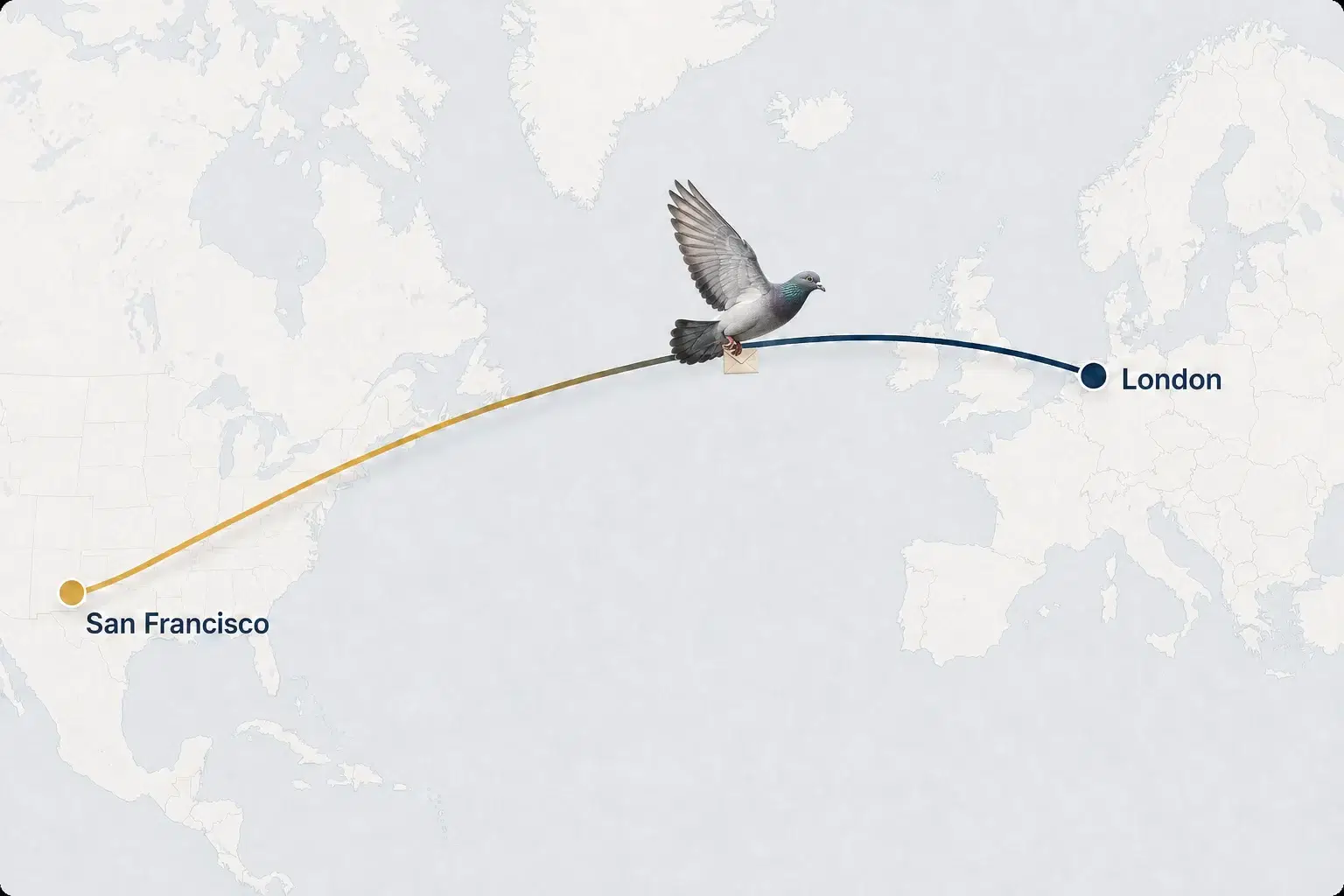
Go one better than boring old What’s App, and send your messages by Carrier Pidge, a virtual carrier pigeon. Called Carrier Pidge, the iOS app deliberately makes messages travel between users rather than delivering them instantly. The farther away your friend is, the longer you’ll be waiting for a reply.
Messages move at 110 mph, with delivery times calculated using the real GPS distance between the sender and recipient.
That means something sent across town could arrive within seconds, sending a message across the US would take hours, and it would take days to reach out to someone on the other side of the world. Watch the bird fly across a map in real time. This is what vibe coding is all about!
“The only excuse for making a useless thing is that one admires it intensely. All art is quite useless.” Oscar Wilde
Talking of fun apps, try Die with Me, the chat app you can only use when you have less than 5% battery on your phone. Die together in a chatroom on your way to offline peace. On it, there is a small community of anxious souls, a club you can only temporarily join, the certainty that your time will soon be up……. “the undiscovered country from whose bourn no traveler returns”
….And for the bird nerds……..Fairly ranking the most brilliant birds……by Ryan Moulton